










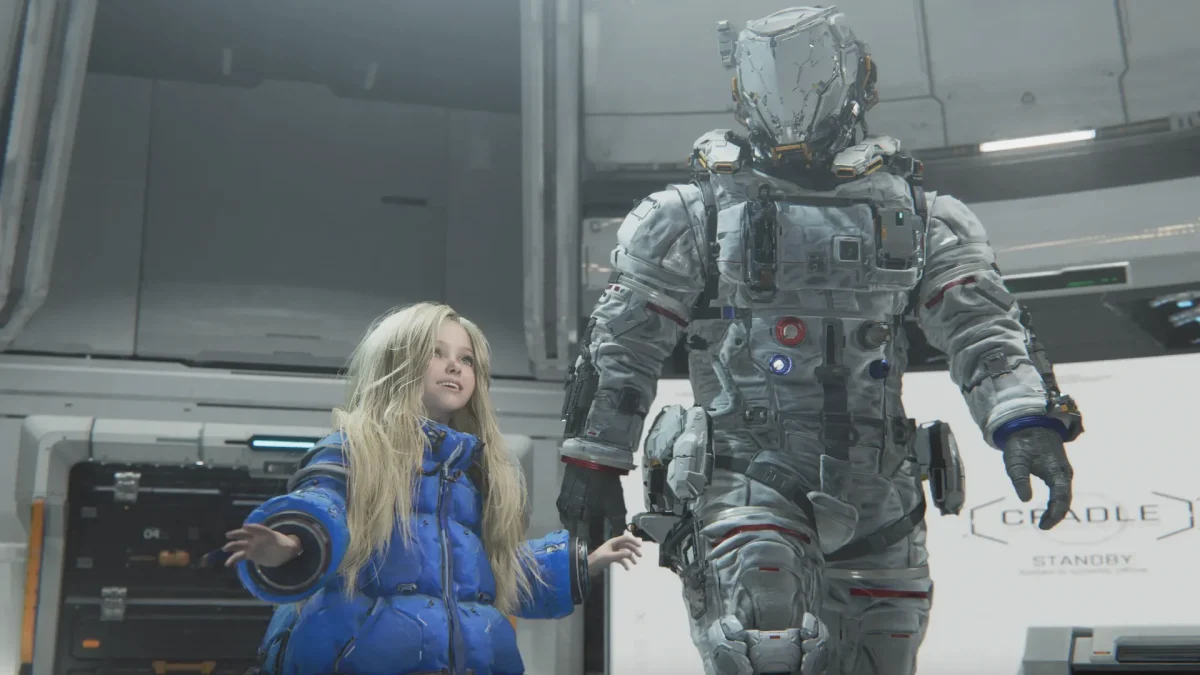








The earth has lost contact with the mining facility on the moon, and it’s your job to find out why. “Pragmata” is a hack-and-shoot sci-fi action-adventure game produced and developed by the game studio CapCom. It was released in April of 2026 on PlayStation 5, Windows, Xbox Series X/S, and Nintendo Switch 2 after many years of being stuck in a sort of development purgatory for around 5 years. The game takes place in a mining facility known as “The Cradle” which is established on the moon by a company called Delphi Corporation to mine a special material which is called Lunafilament and is typically overseen by an artificial intelligence titled the Intelligent Direction Unification System (IDUS) and a large workforce of capable robots.
The story of the game follows a man called Hugh Williams. Hugh was a systems engineer who was sent to the Cradle with a support team by the Delphi Corporation to determine what caused the communication between the Cradle and Earth to be cut off. He and his crew land on the Cradle and find it devoid of any human activity, when a sudden moonquake hits the Cradle, leading to the separation of the group and knocking Hugh unconscious.This is where Hugh gets woken up by a child-like android pragmata who he calls Diana. Diana becomes the plot afterward, helping survive hordes of rogue machines by hacking them and making them more vulnerable to Hugh’s attacks and gaining a bond with Hugh over the game, until he thinks of her more like his own daughter instead of just an android helper.
The game otherwise centers around wandering through the Cradle and finding a way to get signals back to earth, so Hugh can go home, while staying alive, defeating rogue robots, and figuring out what led to the disappearance of the human staff of the Cradle. The story is actually incredibly interesting and allows players to feel like they’re immersed into the story and setting. The layout of the Cradle makes it seem as futuristic as it is implied to be, which makes the game more enjoyable for its player base. The ending has been described as sad or heartbreaking, which may be both a deterrent for some and a reason to play for others.
You meet many npcs and enemies throughout the game’s story, some helpful, some not so much, including another android pragmata who calls themselves “Eight” who tries to convince the player to destroy or shut down IDUS before attempting to contact earth again, and giving Hugh and Diana the code to do so before IDUS locks down Eight’s sector and the player escapes the area. The game is full of more enemies than friends and it might often be described as feeling lonely if not for constantly having Diana along with them throughout the story of the game.
While players wander through the Cradle’s facility, they may begin to notice that the art direction is incredibly realistic and, in some cases, unreal and more akin to what a generative ai model would spit out, which CapCom producer Naoto Oyama confirmed that Generative AI wasn’t used and that “human developers painstakingly worked to incorporate mechanisms that express this Ai-like uncanny feel.” One writer for the PC Gamer magazine, Elie Gould, described it as “human-made AI slop”. This is a really interesting detail for those who enjoy understanding and learning about the design and art direction of games like these.
The game’s antagonists are significantly dangerous to say the least. For most of the game, players don’t get to know much about them for quite some time before they and their plan are revealed, along with their origin and reasoning as to why they wish to do so. The antagonist at the end of the game seeks the destruction of all life on earth by attempting to send large amounts of a byproduct of lunafilament, known as dead filament, in capsules back to earth, to lead to the death of humankind. It is around here that the players also find out the original reason for the creation of the android pragmata, such as Eight and Diana, which is very important to the story, but the player also finds that Diana is considered a failed model by the standards which the pragmata were initially made with.
This game has a lot of interesting mechanics, as well as many details to the point it would take too long to describe them all. The game balances the artistic and storytelling direction really well, leading to a finished product that looks stunning and pulls at the hearts of its players with every bit of the story shown before them. This game is beautifully made, one might call it a piece of art. So, if you like action, games, emotional stories, violence, and stunning visuals, this game is perfect for you, and if you only like one or a few of those things, maybe still check it out,